
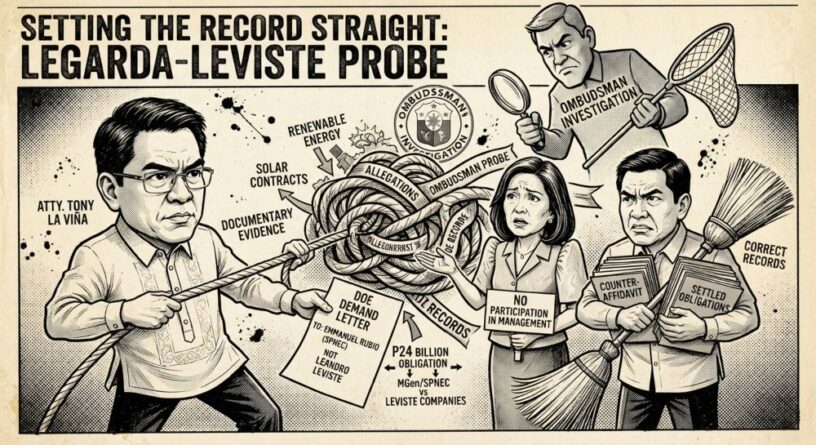



When high-profile public figures and family ties intersect with multi-billion-peso corporate landscapes, the public sits up and takes notice. Recently, the renewable energy sector found itself at the center of a brewing storm as allegations of plunder and graft surfaced against Senator Loren Legarda and her son, Batangas First District Representative Leandro Leviste.
However, in a recent press briefing with digital media, Atty. Antonio “Tony” La Viña—serving as the spokesperson for Senator Legarda—stepped forward to dismantle the narrative. Describing the accusations as both “baseless” and “ridiculous,” La Viña argued that a closer look at the financial and documentary trail tells an entirely different story.
Untangling the Corporate Maze
At the heart of the controversy are massive financial obligations and renewable energy service contracts. Critics have pointed fingers at Representative Leviste, but La Viña was quick to draw a sharp line between distinct corporate entities.
He highlighted a Department of Energy (DOE) demand letter initially asking for 24 billion pesos—later revised to 10 billion pesos—pointing out that this obligation was directed at Mr. Emmanuel Rubio of SP New Energy Corporation (SPNEC), a company majority-owned and controlled by MGen (Meralco’s generation arm) since 2024. According to La Viña, conflating SPNEC’s liabilities with Leviste or his other Solar Philippines companies is a fundamental administrative error.
Furthermore, addressing the defunct Solar Para sa Bayan franchise, La Viña noted that it was non-exclusive and naturally ceased to exist under the law’s automatic revocation clause. The roadblock, he explained, wasn’t corporate malfeasance, but rather the government’s own failure to issue the necessary implementing rules and designate operating areas.
Defending the Solar Portfolio
Leviste’s critics have also raised eyebrows over his acquisition of 42 solar service contracts. Yet, context matters: these represent only a fraction of the 518 solar service contracts awarded nationwide.
La Viña stressed that holding a pre-development service contract is a standard commercial venture fraught with private financial risk. Land availability, grid connectivity, and feasibility hurdles often cause projects to stall—a reality of energy exploration that, as he emphasized, does not automatically translate to corruption or plunder.
Where Does Senator Legarda Fit In?
Perhaps the most perplexing element for supporters has been the inclusion of Senator Loren Legarda in the Ombudsman’s probe. La Viña strongly defended her, maintaining that she never participated in the management of her son’s companies, nor did she ever leverage her public office for private business gains.
“There’s nothing in the charges of the Ombudsman na kasama si Senator Loren Legarda. So, yun, bakit siya nakasama?” La Viña asked, pointing out the glaring absence of evidence connecting the senator to the transactions in question. Both Legarda and Leviste have already submitted their counter-affidavits on time, trusting that the legal process will ultimately prevail.
Key Takeaways at a Glance
- Denial of Public Funds Misuse: Atty. La Viña firmly stated that no government money was ever taken or pocketed by Senator Legarda or Representative Leviste.
- Corporate Distinction: Financial obligations—such as the multi-billion-peso demand letters—belong to separate corporate entities like SPNEC (under MGen), not Leviste.
- Government Delay, Not Malpractice: The unfulfilled implementation of the Solar Para sa Bayan franchise was attributed to the DOE’s lack of implementing rules and designated operational zones, not corporate neglect.
- Standard Business Risks: The 42 solar contracts held by Leviste represent a minor portion of national contracts, and the non-completion of pre-development projects is a standard private investment risk, not graft.
- No Link to Legarda: La Viña challenged the inclusion of Senator Legarda in the complaint, emphasizing she had no management role or financial participation in her son’s ventures.
What Are Your Thoughts?
As this high-stakes legal battle unfolds, it raises important questions about the intersection of family, public office, and corporate transparency in the Philippines. Do you think institutional checks and balances are being applied fairly, or is political noise overshadowing the actual documentary evidence?
Join the conversation below—drop your thoughts in the comments, share this article with your community, and let’s keep local discourse informed, objective, and engaged!

- HONOR 600S and VIVA to Create Magic with AI Image-to-Video - September 28, 2026
- Over October to Take the Stage One Last Time with its Original Five-piece Lineup - September 28, 2026
- Manulife Philippines Earns International Sustainability Honor, Wins Quill Award for Longevity Campaign - September 28, 2026
























Leave a Reply