
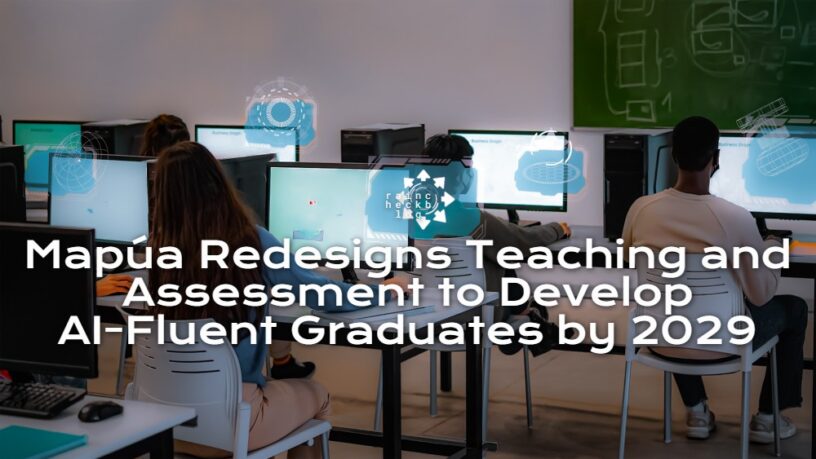



Building on a strong track record in which 89% of Mapúa graduates land a job within the first six months after graduation (Mapúa University 2024-2025 Graduate Employability Data), Mapúa Education Group (MEG) is taking deliberate steps to keep its students ahead in a rapidly evolving job market. As part of iPeople, Inc.’s goal of developing 200,000 AI-fluent learners by 2029, MEG is transforming how students learn and demonstrate competence by embedding artificial intelligence (AI) into curriculum design, classroom instruction, and academic assessment. This ensures graduates are equipped to secure the careers they want immediately upon entering the workforce.
“We have moved from teaching students merely to use digital tools toward teaching them to exercise sound professional judgment while working with AI,” said Dr. Jennifer Chua-Dela Cruz, Dean of Mapúa University’s School of Artificial Intelligence, Electrical, Computer and Electronics Engineering (AIECEE). “The change is not about making assignments easier or automating students’ thinking. It is about requiring them to question, verify, improve, and defend AI-assisted work.”
From AI Use to AI Fluency
A key part of this transformation is the explicit classification of AI use in student assessments, establishing clear boundaries while preparing learners for workplaces where AI is increasingly part of professional practice.
Under the framework, assessments are classified as AI-prohibited, AI-assisted, or AI-integrated. Students may use AI in designated activities to explore research questions, organize information, or critique early drafts. However, they remain responsible for verifying claims against scholarly databases, evaluating sources, applying professional judgment, and disclosing their use of AI.
Faculty may also require students to submit prompts, drafts, revision histories, and reflection notes to document their work. Oral presentations and defenses provide opportunities for students to demonstrate their understanding and justify their decisions.
This approach evaluates both the finished work and the intellectual process behind it, reflecting Mapúa’s broader shift from content delivery to cognitive coaching and from product-based to process-based assessment.
Redesigning Assessment and Supporting Faculty
To strengthen academic integrity and faculty readiness, Mapúa is establishing the AI Teaching Commons, supported by faculty training, assessment-redesign clinics, digital course templates, communities of practice, and train-the-trainer programs.
These initiatives help educators redesign learning outcomes and assessments while strengthening their role as cognitive coaches who guide students through questioning, feedback, and the development of professional judgment.
Students may be asked to demonstrate competence through supervised examinations, oral defenses, live problem-solving, iterative drafts, AI-use documentation, reflections, and practical demonstrations. Regardless of the tools they use, students remain accountable for the accuracy, originality, and ethical integrity of their work.
Mapúa is also addressing workload and equitable access. For example, the CRAFT framework—Culture, Rules, Access, Familiarity, and Trust—guides responsible use, access to tools, privacy, fairness, and human accountability as students and faculty do their own work.
Measuring Progress Through Evidence
As the strategy enters full implementation in Academic Year 2026–2027, the strongest evidence of progress lies in changes to course design and assessment practices. These include explicit AI-use classifications, requirements to document and defend AI-assisted work, protected assessments for independent mastery, and syllabi incorporating responsible-AI policies, HyFlip delivery, and workload planning.
Comparative student-performance data and consolidated on-the-job training (OJT) employer survey results are not yet available. Future evaluation may include a common employer-assessment framework examining graduates’ ability to use AI appropriately, verify outputs, identify bias, protect confidential information, explain decisions, and work independently. These findings can be assessed alongside student portfolios, oral defenses, supervisor feedback, and academic performance.
“We can already demonstrate that the architecture of teaching and assessment has changed. We will claim improved student or employer outcomes only after baseline and follow-up data confirm them,” Chua-Dela Cruz said.
Through its AI-Fluency Strategy, Mapúa aims to give graduates an unmistakable competitive advantage in landing their target roles after college. The institution seeks to develop graduates who can work effectively with emerging technologies while exercising critical thinking, ethical judgment, and professional responsibility needed in an increasingly AI-enabled workplace.
To learn more about Mapúa’s AI-Fluency Strategy and academic offerings, visit www.mapua.edu,ph.

- Converge SME Head Appointed to ISA Steering Committee for PH Startup Development - November 29, 2026
- Watsons x Unilab Share the Alaga Run Year 2 - November 29, 2026
- Unwrap Your Wishlist with LazMall Luxury’s Well-Deserved Holiday Deals - November 29, 2026

























Leave a Reply