
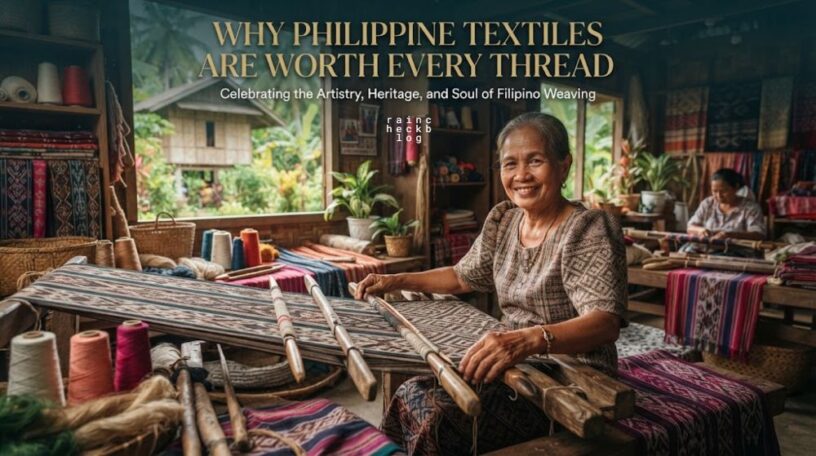


At any given time, in any given crowd in Manila, one can spot people wearing indigenous weaves. For some, it is a modest chest pocket on a shirt or a twist of a sleeve on a blouse. For others, it is a statement tapis or a dramatic tiered skirt. What was once considered old-fashioned, or relegated to blankets and tablecloths in ancestral homes, has found its way into the streets of the city, becoming a source of pride for the wearer.
From a moment to a movement, this newfound appreciation for Filipino textiles is deeply entwined with the efforts of HABI: The Philippine Textile Council and its flagship event, the Likhang Habi Market Fair. Now in its 16th year, the Fair brings together weavers, weaving communities, artisans, designers, and textile entrepreneurs who have taken one of the world’s oldest crafts and infused it with innovation to create pieces that are relevant, timeless, and unmistakably Filipino.
From a Moment to a Movement
Today, the Fair attracts personal shoppers, international buyers, and everyone in between. It has become an important fixture in the Philippine fashion calendar. Yet, in its early years, enticing exhibitors to set up a table was a challenge.
HABI President Emeritus Adelaida Lim, who has been there from the beginning, remembers when the Fair had just 30 booths.
“Having been there from the beginning, I’ve seen the fair get bigger and bigger,” she reminisced. “It was very encouraging… nakakataba ng puso to see the interest that has grown and to see how people have started to wear Filipiniana not just for special occasions but even to go to the office. So, it is no longer a costume, so to speak. It is already integrated into daily living.”
But with growth came a new challenge: helping people understand the value of the textiles they wear and buy. Thus, the theme of this year’s Fair is “Worth Every Thread.”
Understanding the Value of the Weave
“There have been many years when we’ve been asked, ‘Bakit ang mahal ng weaves?’ We decided to turn the question around: Why is the weave worth that much? What kind of skill, craftsmanship, time, and physical labor go into every piece?” explained HABI Council President Mia Villanueva.
“When you understand what goes into making something by hand, using indigenous fibers and traditional skills, you begin to see why it is worth every thread.”
That appreciation begins long before a textile reaches the market. It starts with the land where the fibers are grown and extends through the many hands and processes involved in transforming them into cloth.
“There’s no less than 80 ethno-linguistic groups in the Philippines, and each one would have their own material culture and textiles,” explained Dr. Norma Respicio, Professor Emeritus from the Department of Art Studies of the University of the Philippines, Diliman. “You can just imagine the richness of Philippine culture in textiles alone. Each one would have not just their own designs but their own materials, like abaca or piña.”
She points to abaca as an example of the history, ingenuity, and labor embedded in Philippine textiles. From farms in remote highlands to the preparation of fibers and the weaving itself, the process involves numerous stages and communities.
“There are so many processes. Prior to weaving, there are so many preparations. That’s why this textile weaving culture in the Philippines, particularly abaca, really shows us the ingenuity of the Filipinos,” she added.
From Fiber to Livelihood
This ingenuity is reflected in the work of local entrepreneurs such as Jeanafer Fernandez of Piña Seda Primera and Gloria Lim of Rurungan Collective, whose businesses are rooted in the potential of indigenous fibers to create livelihoods and sustain communities.
Fernandez was born into the piña-weaving industry. Her mother was a pioneer piña weaver in Aklan, and weaving was an integral part of her childhood. She saw firsthand how the industry sustained families and provided work for local communities.
After taking over her mother’s business, Fernandez pursued training and began joining trade fairs. Her first Likhang Habi Market Fair in 2017 proved to be a turning point.
“HABI is my first love!” she declared. “That was where I gained experience and learned to talk to people, especially customers who would appreciate the products. I’m so grateful to God and to HABI because that was where I was able to showcase the products that I really want to be known for while helping artisans, weavers and embroiderers.”
Today, Piña Seda Primera is known for formal wear made from premium piña, enhanced by distinctive embroidery.
For Lim, weaving was likewise a family endeavor. Rurungan sa Tubod Foundation was established in Palawan as an alternative livelihood initiative for communities affected by efforts to curb environmentally harmful practices such as kaingin and mining.
“The reason why we went to weaving was because it was a dignified way for them to provide livelihood for their families and be in charge of their own time,” she explained. “It was to give them the choice to stay with their family, provide livelihood and create their own path to empower the women of those areas.”
The community worked together to develop skills across the production process, from growing and extracting fibers to preparing them for weaving and maintaining the looms. While weaving was not historically indigenous to the area in the same way it is in other parts of the Philippines, Rurungan developed contemporary and collaborative products while keeping the community at the heart of its work.
For Lim, the Likhang Habi Market Fair became an important link to the market. She recalls the excitement of students buying handmade products and the sense of accomplishment that came with seeing their work appreciated. “Oh! We made it!” she remembers thinking.
HABI’s work with weaving communities extends beyond the annual market fair and into the grassroots. In Catanduanes, the organization has undertaken the Panganiban Weaving Center project, reflecting its commitment to supporting local weaving initiatives and bringing opportunities for livelihood and cultural preservation to communities beyond the country’s major textile centers. It is one example of how HABI’s work reaches communities where traditional skills and weaving traditions continue to find meaning and purpose.
Kwentong Kultura, HABI Lectures: Preserving the Stories Behind the Threads
While the Likhang Habi Market Fair has become a destination for fashion and design, its purpose extends beyond the finished product. At its core is the preservation of the knowledge, skills, and communities that give Philippine textiles their meaning.
This is where Kwentong Kultura, HABI Lectures, the Fair’s series of talks and panel discussions, comes in. Introduced last year, the program gives visitors a deeper understanding of the processes, challenges, and traditions behind the products they encounter. Following a positive reception, it returns this year with discussions on the issues and opportunities facing weaving communities.
For Professor Corazon “Cora” Alvina, a board member of HABI: The Philippine Textile Council, these conversations are an essential part of the organization’s conservation advocacy.
“The overarching idea of HABI, which includes lectures and discussions, is the objective of conservation,” she explained. “Conservation is not only the safekeeping of the physical, the tangible, but also that of the knowledge surrounding weaving and clothing.”
By bringing these stories and forms of knowledge to a wider audience—including students, practitioners, and entrepreneurs—Kwentong Kultura, HABI Lectures helps ensure that the traditions behind the textiles remain understood, valued, and carried forward.
What Every Thread Means
Ultimately, the fashion that emerges from the Likhang HABI Market Fair is a celebration of the communities that give Philippine textiles their soul. Each garment or woven product carries traces of the land, the labor, the skill, and the aspirations of the people who made it.
For Gloria Lim, the value of a textile goes beyond its appearance or even its sustainability. It lies in the meaning people attach to it and the care that goes into making and keeping it.
“One main thing that I really learned and was ingrained in me, I was super against emotional design. When I studied product development and design, it doesn’t matter how sustainable your product is, if people don’t care. From the makers all the way down to the people buying it, if they will throw it away tomorrow, it doesn’t matter,” she reflected.
“And within the community, from the plant all the way down to the loom, the fiber, the thread, it all matters.”
For Lim, that is the essence of Worth Every Thread—recognizing the people behind what we buy, the land from which materials come, and the communities that depend on the work.
“It’s about knowing the person who makes it. Knowing what’s important to you. Having these items that are handmade, you know where it is. Everything is from the land. That’s a luxury most people don’t know anymore.”
And perhaps, she adds, that value is ultimately measured in the simplest things: having a community around you and being able to put food on the table.
The 16th Likhang Habi Market Fair, with the theme “Worth Every Thread,” will be held on October 9–11, 2026, at SPACE One Ayala, Makati.
The fair is made possible with the generous support of corporate sponsors: Gold Sponsor – SM Investments Corporation, Silver Sponsors Philippine Gaming and Amusement Corporation (PAGCOR), Okada Foundation Inc., Bronze Sponsors Mr. D.I.Y. Philippines, AY Foundation Inc., Marubeni Philippines Corporation, STI Education Systems, Kwentong Kultura, HABI Lectures Donors Gramans Group of Companies, Nobleland Ventures Inc. and Media Partners DiscoverMNL, DZRJ 810 AM, Malaya Business Insight, Our Awesome Planet, Chinoy TV, and WhenInManila.com.

- Why Philippine Textiles are Worth Every Thread - September 22, 2026
- McDonald’s and G-DRAGON Unite for ‘Asia Chicken Campaign’ - September 22, 2026
- PETA Brings Back “Mga Kuwento ni Lola Basyang” for a New Generation - September 22, 2026





















Leave a Reply