
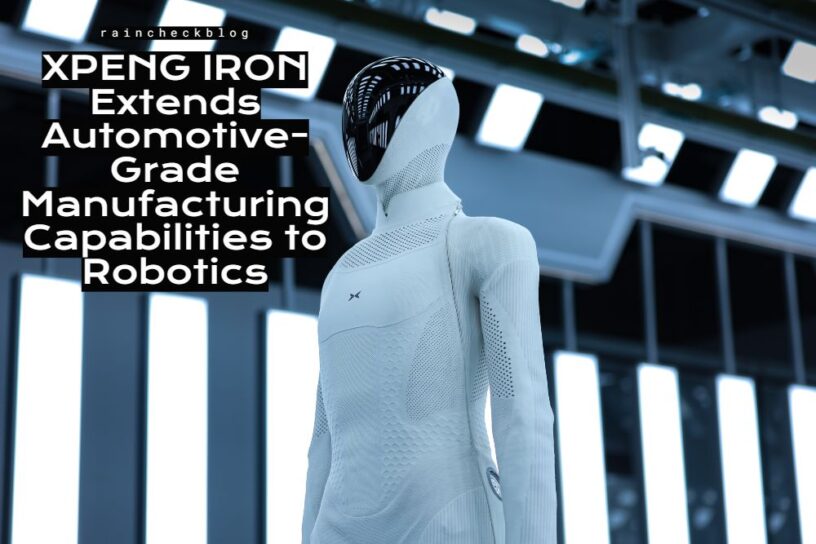



XPENG Inc., a leading global Physical AI company, has officially commissioned its humanoid robot production lines, marking a significant step in the company’s move from research and development to scaled manufacturing.
The milestone was marked by the completion of the first next-generation XPENG IRON produced on the new lines. The advanced general-purpose humanoid robot autonomously walked off the production floor, demonstrating the transition from R&D prototyping to production and bringing XPENG closer to volume manufacturing.
According to the company, the facility operates the world’s first automated production lines for advanced humanoid robots. It applies automotive-grade quality systems developed for the smart electric vehicle industry to the precision manufacturing of humanoid machines.
Built with scalability in mind, the facility automates more than 80% of its core processes. Its high-precision, flexible, and intelligent manufacturing system is designed to maintain consistent quality across critical stages while supporting faster capacity expansion.
He Xiaopeng, Chairman & CEO of XPENG, said: “The robot production lines were created from scratch with no precedent to follow. Today’s step is small, but XPENG is building the production lines for an entirely new product category. Looking ahead, XPENG will continue to explore faster production rhythms and greater scale in robot manufacturing, charting a new path toward a leading robot manufacturing industry in China and globally.”
A key pillar of the company’s Physical AI strategy, the next-generation XPENG IRON combines human-like form and movement with AI-driven intelligence. Designed to meet stringent safety standards, it is being developed as an advanced general-purpose humanoid platform capable of supporting a wide range of applications and continuously improving through real-world learning and self-reinforcement.
IRON features a proprietary, fully enclosed flexible lattice structure designed to balance aesthetics and safety. With 76 degrees of freedom across its body and 21 in each hand, the robot delivers high levels of dexterity and mobility.
Its intelligence is supported by three AI Turing chips capable of delivering up to 2,250 TOPS of computing power. This allows XPENG to deploy its Physical AI foundation model directly on the robot, enabling IRON to perform complex tasks autonomously without remote operation while providing low-latency inference and stronger data security.
Mr. He added, “We aim to build a new type of robot with full generalization capabilities that can truly become part of everyday life, create a better life for people, and ultimately become a companion in their lives.”
XPENG plans to begin mass-producing its robots by the end of 2026, with initial commercial deployment at the company’s stores and campuses. The official market introduction and delivery of the robots in China and overseas markets are scheduled for 2027.
The production milestone comes as XPENG prepares to officially launch in the Philippines on September 25, 2026. The event will introduce the brand’s Physical AI vision to the local market alongside the Philippine debut of the XPENG X9 and XPENG L03.
The X9 is XPENG’s ultra-intelligent flagship seven-seater, combining premium comfort, flexible interior space, and intelligent mobility technologies. Its features include the Intelligent XOS Cockpit, XPILOT ASSIST driver assistance, active rear-wheel steering, and an intelligent dual-chamber air suspension system. The model is designed to serve as an executive lounge, a premium family vehicle, and an adaptable companion for everyday travel.
Joining it is the L03, a next-generation AI SUV coupé that brings together intelligent technology, distinctive design, everyday versatility, and connected mobility. Together, the two models will demonstrate how XPENG applies artificial intelligence to vehicles designed to understand, adapt, and respond to the people who use them.
The Philippine launch forms part of the company’s wider globalization strategy and its ambition to bring Physical AI into more markets and areas of daily life. Full details on local pricing, variants, warranties, availability, and delivery schedules will be announced during the September 25 event.
Beyond intelligent vehicles, XPENG is developing automotive, robotics, and globalization as three complementary growth pillars. The rollout of its first production-line-built advanced general-purpose humanoid robot marks another significant step in the implementation of this strategy.
Given the technical barriers and limited supply of advanced general-purpose humanoid robots, XPENG expects gross margins per unit in the segment to be significantly higher than those of new energy vehicles. As its robotics business moves toward scaled manufacturing and commercialization, the company expects it to emerge as its second major growth engine.
On August 24, XPENG’s robotics business entered into share purchase agreements with multiple investors, raising more than US$900 million at a post-money valuation exceeding US$6.3 billion. According to the company, the transaction represents the largest single-round private capital raise in China’s embodied AI industry to date.
The investment reflects capital-market confidence in XPENG Group’s technological capabilities, development roadmap, manufacturing scale, and long-term commercial prospects in Physical AI.
By connecting a unified Physical AI foundation model with intelligent vehicles, humanoid robots, and scalable production capabilities, XPENG is building an integrated chain from foundational technology and product development to industrial deployment. Through this strategy, the company aims to bring artificial intelligence beyond the digital realm and into vehicles, robots, and the wider physical world.

- Beat the Holiday Rush: Decathlon Offers Budget-Friendly Shopping This 9.9 - September 9, 2026
- M1ss Jade So Unveils a Devilish Drag Look and a New Song of the Same Name, “BAPHOMETA” - September 9, 2026
- Lenovo Expands Its Gaming Lineup with New LOQ Essential PCs and Legion Monitors - September 9, 2026


























Leave a Reply