



Let’s face it: navigating the local economic landscape today feels a lot like commuting during rush hour on EDSA. Between fluctuating inflation rates, rising utility bills, and the constant fear of sudden market shifts, relying solely on a 9-to-5 corporate salary can feel like running on a treadmill.
For the Filipino middle and lower-middle class, finding financial security requires more than just saving—it demands active, smart diversification.
The good news? You don’t need a massive trust fund or millions in venture capital to insulate yourself from economic downturns. History shows that some of the most resilient business empires were born out of tight corners and modest beginnings.
Here are practical, recession-proof money-making activities inspired by local moguls who started with next to nothing.
1. Micro-Reselling Essential Consumer Goods (The “Mercury Drug” Blueprint)
When times get tough, luxury spending drops, but basic consumer needs—food, hygiene products, affordable medicine, and household cleaners—skyrocket in demand.
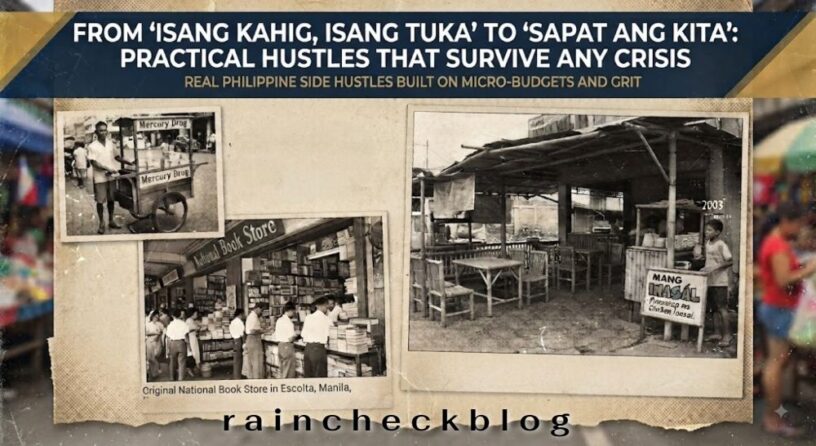
- The Local Play: You don’t need to open a massive pharmacy like National Artist of Retailing inspiration Mariano Que, who famously started by selling single-dose sulfathiazole antibiotics from a wooden pushcart. Instead, tap into the hyper-local demand within your barangay or subdivision by bulk-buying high-turnover consumer goods.
- How to Execute: Source affordable cleaning supplies, pantry staples, or generic health essentials from wholesale hubs like Divisoria or local distributors. Break them down into tingi (retail) or household-friendly bundle packs. Sell them via Facebook Marketplace, community Viber groups, or a small neighborhood sari-sari setup.
- Why it’s Recession-Proof: People will always need soap, detergent, and basic medicine, regardless of the inflation rate.
2. Value-Added Service Arbitrage (The “National Book Store” Pivot)
Economic shifts often disrupt supply chains, but they also create gaps where nimble service providers can step in.
- The Local Play: Think of “Nanay” Socorro Ramos, who started National Book Store with a tiny capital of just P211. When World War II and subsequent economic restrictions barred imported books, she didn’t close shop—she pivoted to selling locally sourced items like candles, soap, and handmade school supplies.
- How to Execute: Look around your neighborhood or office. What skills or educational materials are people scrambling for? If you have digital skills, offer document formatting, résumé writing, or affordable bookkeeping for micro-enterprises. If you are handy, offer appliance cleaning or bicycle maintenance services right at your clients’ doorsteps.
- Why it’s Recession-Proof: Skills and localized problem-solving are assets that cannot be devalued by currency inflation. When companies cut back on full-time hires, they turn heavily to agile freelancers.
3. High-Demand Affordable Food Retailing (The “Mang Inasal” Concept)
Filipinos love comfort food, and comfort food remains a recession-proof sector because it acts as an affordable luxury during stressful economic periods.
- The Local Play: Edgar “Injap” Sia was only 26 when he launched Mang Inasal in a simple Iloilo parking lot, leveraging a distinct value proposition: satisfying, heavy meals centered around rice and chicken that fit the working-class budget.
- How to Execute: You don’t need to build a nationwide restaurant chain overnight. Start a micro-food business focusing on high-margin, filling comfort foods (such as frozen ready-to-fry local delicacies, baked goods, or specialized rice meal packs) delivered via local courier apps like Lalamove or Foodpanda, targeting office workers or busy neighborhood families.
- Why it’s Recession-Proof: Even when budgets tighten, people look for accessible treats to boost their morale. Affordable, filling comfort food consistently outperforms high-end dining during downturns.
4. Digital Skill Monetization and Content Micro-Consulting
With the massive digital migration of Philippine commerce, specialized digital literacy is the modern equivalent of John Gokongwei’s humble trading cart—it requires minimal physical capital, just sharp execution and consistency.
- The Local Play: Global brands and local SMEs alike are trimming down marketing budgets, opting to hire remote freelance digital assistants, graphic designers, or content editors on a project basis instead of retaining expensive agencies.
- How to Execute: Capitalize on your existing daytime skills (whether it’s data entry, customer service, basic video editing, or social media management) and pitch directly to small business owners on platforms like Upwork, OnlineJobs.ph, or local Facebook business networks.
- Why it’s Recession-Proof: Earning in foreign currencies (USD, AUD, SGD) while living in the Philippines acts as a natural macroeconomic hedge against peso depreciation.
Final Thoughts: The Mindset of Resilience
Building wealth in a developing economy isn’t about avoiding risks entirely; it’s about starting small, staying adaptable, and observing what your immediate community lacks. Whether you’re setting up a micro-reselling gig after your day job or offering specialized digital services, the formula remains identical to the giants who came before us: grit, resourcefulness, and an absolute willingness to start from where you are.

- Santé International Inducted into DSAP, Reinforcing Commitment to Ethical Direct Selling - October 22, 2026
- Rethinking Nicotine: Inside the Push for Broader Tobacco Harm Reduction Across Asia - October 19, 2026
- Rediscover the Magic: I Heart PH Takes You on an Unforgettable Journey to Hong Kong in Season 11 - October 19, 2026

























Leave a Reply