
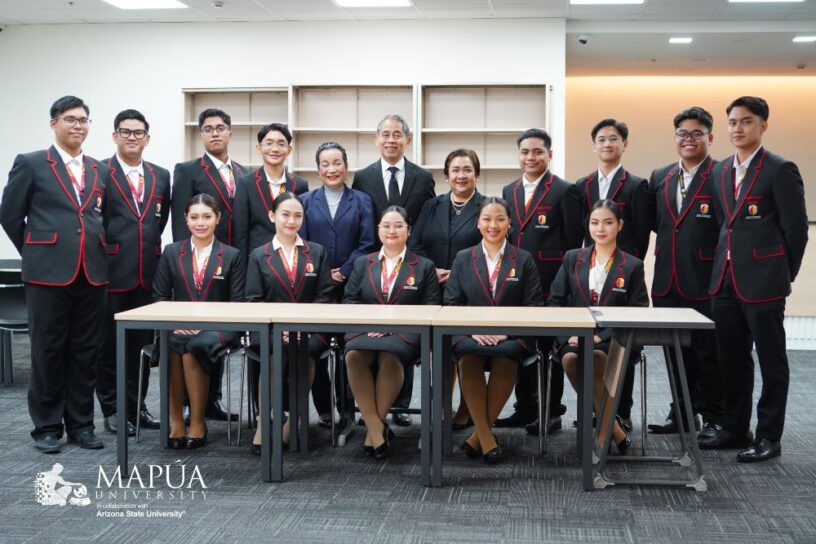


In an era where global travel is being redefined by AI-driven booking, smart-room technology, and data-backed guest experiences, the Philippine tourism sector faces a critical question: Are we producing enough digital-ready specialists to lead the charge? According to global think tank Organisation for Economic Co-operation and Development’s (OECD) report on “Preparing the tourism workforce for the digital future,” digitalization is no longer a luxury but a requirement for survival in the global hospitality market. Mapúa University is answering this call by humanizing the high-tech, ensuring its students—like 18-year-old Irish Dominique “Nique” Belino—are not just observing the digital shift, but leading it.
The Heart of Service meets the Logic of Technology
For Nique, a first-year student from Batangas, tourism was a calling rooted in family and culture. Encouraged by her parents to merge her love for travel with a professional edge, the Mapúa Senior High School alumna returned to her alma mater to pursue her degree.
“Mapúa is where global standards meet discipline,” Nique shares. “I knew that if I wanted to be more than just a participant in this industry—if I wanted to be a leader—I needed a school that understood the intersection of service and technology.”
Now in her first year, Nique is already diving into the complexities of “Intelligent Systems” and “People-Centered Services.” Her curriculum moves beyond traditional memorization, focusing instead on how management, strategy, and digital operations work in concert to deliver superior guest experiences.
A Classroom Without Borders
Mapúa’s School of Tourism and Hospitality Management (STHM) bridges the gap between the classroom and the global stage. Students are immersed in digital operations mastery where they will learn customer management systems to advanced booking platforms used by top-tier global partners; data-driven decision making, encouraging students to use research and digital tools to predict travel trends and guest needs; immersive real-world simulations using case studies and hands-on training that mirror the high-stakes environment of international luxury hotels and travel agencies.
“Even as freshmen, we are trained to develop a professional mindset,” Nique adds. “We don’t just learn concepts; we apply them to realistic scenarios. It makes the learning feel real, and it makes the future feel reachable.”
Shaping the Leaders of Tomorrow
By integrating business principles with technological proficiency, Mapúa accelerates the capabilities of its learners. Students explore the strategic sides of the industry—including tourism planning and hospitality marketing—ensuring they graduate with the critical thinking skills required to innovate.
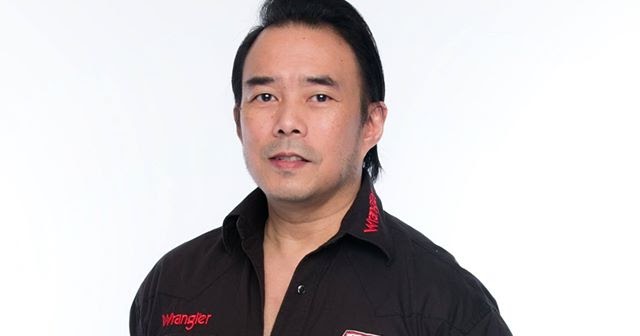
“Through research and industry immersion, our students develop a global perspective that is rare in today’s market,” says Jhuan Paollo Sebastian, Professor at the Mapúa STHM. “We aren’t just teaching them how to work in a hotel; we are teaching them how to manage the future of the global hospitality sector.”
As Nique and her peers continue their journey, the Philippine tourism sector can look forward to a new wave of digitally competent, service-oriented experts. The future of Philippine hospitality isn’t just coming—it’s being built at Mapúa.
To learn more about Mapúa’s Hospitality Management and Tourism Management programs, visit www.mapua.edu.ph and begin your journey to a world-class, future-focused education today.

- Tech, Trends, and Triumphs: A Recap of the Taiwan Excellence Pavilion at Taiwan Expo 2026 - September 30, 2026
- Balancing Today’s Bills and Tomorrow’s Dreams: A Guide for Gen Z and Millennials - September 29, 2026
- HONOR 600S Pre-Order Promo: Win a PHP 1 Million Shopping Spree - September 29, 2026






















Leave a Reply