
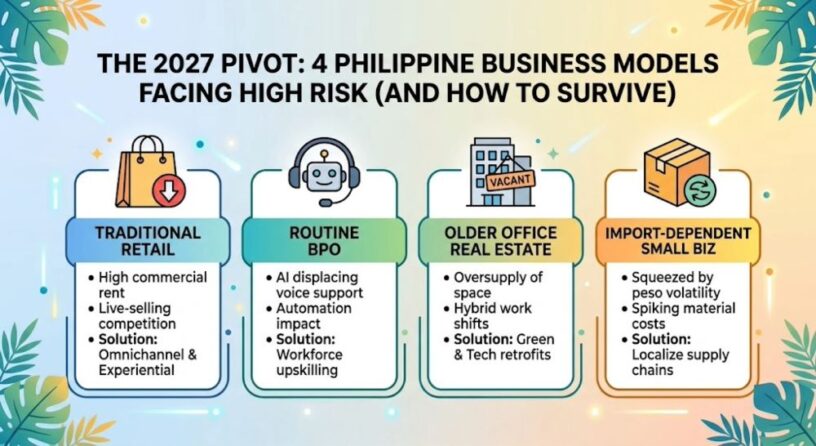



The Philippine economic narrative for 2027 is one of rapid evolution. While consumer demand remains vibrant, business models that operated on autopilot for the past decade are colliding with sharp macro headwinds. Persistent foreign exchange volatility, localized supply chain pressures, shifting work habits, and rapid AI deployment are redefining what it takes to stay profitable.
Understanding these shifts isn’t about panicking—it’s about spotting vulnerabilities early and building agile, forward-looking strategies. Here are four sectors facing structural challenges as we approach 2027, along with practical steps to pivot.
1. Traditional Physical Retail & Unspecialized Malls
The Challenge: Post-pandemic foot traffic has stabilized, but walk-in dependent retail stores and unspecialized clothing boutiques are feeling the squeeze. High commercial lease rates in primary Metro Manila hubs are colliding with aggressive price competition from live-selling, TikTok Shop, and fast e-commerce fulfillment.
- Core Risk: Margin compression.
- Underlying Driver: High rental overhead vs. low-barrier social commerce.
Practical Pivot Suggestions
- Develop Experiential Hooks: Transform stores into spaces consumers must visit in person—think interactive product testing stations, community workshops, or exclusive in-store customization.
- Adopt Omnichannel Retailing: Integrate physical inventory with digital storefronts. Offer “Buy Online, Pick Up In-Store” (BOPIS) to drive foot traffic while capturing digital sales.
2. Routine BPO Operations (Basic L1 & Voice Support)
The Challenge: The Business Process Outsourcing (BPO) sector remains a critical pillar of the local economy, but transactional, low-end voice support and routine Level 1 technical assistance face rapid displacement. Generative AI workflow agents and autonomous conversational tools continue to absorb high volumes of standardized customer inquiries.
- Core Risk: Contract and job displacement.
- Underlying Driver: Rapid adoption of conversational AI and automated customer service workflows.
Practical Pivot Suggestions
- Aggressive Workforce Upskilling: Transition teams from basic tier-1 troubleshooting toward specialized high-margin domains: healthcare tech, financial compliance, data analytics, and AI model oversight.
- Position as Human-in-the-Loop Experts: Market support services around complex empathy-driven problem solving and critical escalation handling that automated systems cannot resolve.
3. Non-Modernized Metro Manila Office Real Estate
The Challenge: A surge in cumulative office supply, combined with flexible hybrid work structures and disciplined corporate spending, has created downward pressure on legacy commercial space. Commercial landlords holding older or mid-rise properties are seeing prolonged vacancy rates.
- Core Risk: Oversupply and rising vacancies.
- Underlying Driver: Hybrid work adoption and shifts toward green, tech-enabled buildings.
Practical Pivot Suggestions
- Retrofit for Sustainability & Tech: Invest in smart energy management, upgraded fiber infrastructure, and green building standards (e.g., LEED certification) to meet international corporate tenant requirements.
- Offer Flexible Co-Working Conversions: Divide large traditional floors into adaptable, plug-and-play spaces or event venues tailored to hybrid enterprise teams and small businesses.
4. Import-Dependent Micro-Retailers & Importers
The Challenge: Fluctuations in the foreign exchange rate directly inflate costs for imported raw materials, finished consumer goods, and ingredients (such as specialty meats, dairy, and wheat). Micro-retailers and small food businesses struggle to pass these cost hikes to inflation-conscious domestic consumers without sacrificing sales volume.
- Core Risk: Spiking input costs and margin erosion.
- Underlying Driver: Persistent peso depreciation and global supply fluctuations.
Practical Pivot Suggestions
- Localize Supply Chains: Partner with local agricultural producers and domestic manufacturers to reduce reliance on import logistics and foreign currency exposure.
- Optimize Value Engineering: Streamline product menus or retail portfolios to focus on high-margin core items, using flexible bundled offerings to maintain order value.
At-a-Glance Risk Summary Matrix
| High-Risk Sector | Core Risk Factor | Primary Driver | Strategic Priority |
|---|---|---|---|
| Traditional Physical Retail | Margin compression | High mall rentals vs. dominant social commerce | Omnichannel fulfillment & experiential stores |
| Routine/Voice BPO Operations | Job/contract displacement | Rapid adoption of conversational AI agents | Workforce upskilling to specialized tech/analytics |
| Non-Modernized Office Real Estate | Oversupply & vacancies | Hybrid work adoption & demand for green spaces | Smart building upgrades & flexible office layouts |
| Import-Dependent Micro-Retail | Spiking input costs | Peso depreciation & global import expenses | Supply chain localization & product bundle optimization |

- OnlyFun.PH Announces VMX Stars Angeli Khang and Robb Guinto as Ambassadors - November 3, 2026
- Allianz PNB Life PANATAG: Creating New Possibilities for Young Single Mothers - November 3, 2026
- The 2027 Pivot: 4 Philippine Business Models Facing High Risk (and How to Survive) - November 3, 2026

























Leave a Reply