
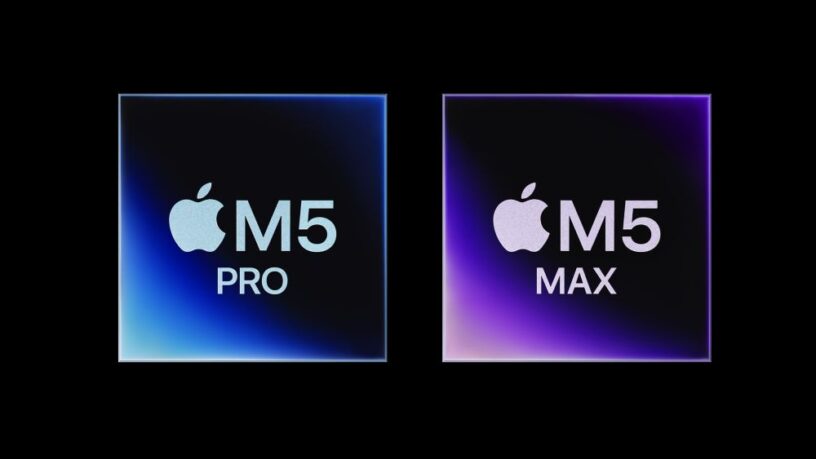



If you recently bought a high-end laptop, I have some bad news: it just became a museum piece.
Apple has finally pulled the curtain back on the M5 Pro and M5 Max, and they didn’t just iterate—they re-engineered the very definition of a “chip.” By introducing a world-first Fusion Architecture, Apple is now physically fusing two dies into a single System on a Chip (SoC).
The result? Performance that doesn’t just nudge the needle; it snaps it off. Here is why the tech world is currently scrambling to keep up.
The “Fusion” Breakthrough: Two Brains, One Heart
The secret sauce this year is the Fusion Architecture. By using advanced packaging to connect two third-generation 3-nanometer dies with high bandwidth and ultra-low latency, Apple has created a unified powerhouse.
Think of it like a dual-engine jet where the engines are so perfectly synced they act as one. This architecture houses an 18-core CPU featuring:
- 6 “Super Cores”: The world’s fastest CPU cores, period.
- 12 Performance Cores: Optimized for multithreaded efficiency that handles massive datasets like they’re simple Word docs.
The payoff? A staggering 30% boost in pro workload performance over the M4 generation, and a mind-melting 2.5x jump over the M1 Pro/Max.
The AI Juggernaut: 4x the GPU Compute
We’ve heard “AI” a thousand times this year, but Apple is actually putting the hardware behind the hype. The new GPU architecture (up to 40 cores on the M5 Max) now includes a Neural Accelerator in every single core.
| Stat | M5 Pro/Max Achievement |
| Peak GPU Compute for AI | Over 4x faster than M4 generation |
| Ray Tracing | Up to 35% faster rendering |
| Unified Memory | Up to 128GB (M5 Max) |
| Memory Bandwidth | Blistering 614GB/s (M5 Max) |
For 3D animators using Cinema 4D or researchers running Local Large Language Models (LLMs) in LM Studio, this isn’t just a “fast” computer—it’s a localized supercomputer.
M5 Pro vs. M5 Max: Which Monster Do You Need?
The M5 Pro: The Data Scientist’s Dream
Designed for those who live in MATLAB, Xcode, or Logic Pro. With a 20-core GPU and support for up to 64GB of unified memory, it delivers 6x the AI performance of the original M1 Pro. It’s the sweet spot for heavy lifting without going into “overkill” territory.
The M5 Max: The 3D Artist’s Weapon
If your job involves 3D rendering in Houdini or editing 8K ProRes video, this is the only choice. It doubles the GPU cores of the Pro and provides enough bandwidth to generate tokens for massive AI models at speeds that feel like magic.
Industry-First Safety and Speed
Apple didn’t just stop at raw speed. They’ve integrated Memory Integrity Enforcement—an industry-first, always-on hardware safety feature that protects your data without slowing the system down.
And for the port-obsessed? Every single Thunderbolt 5 port on these machines is driven by its own custom-designed controller on the chip. No more bottlenecks; just pure, high-speed connectivity for daisy-chaining displays and high-speed storage.
The Bottom Line
With the M5 family, Apple isn’t just competing with other laptop manufacturers anymore; they are competing with physics. By fusing dies and embedding AI accelerators directly into the GPU, the MacBook Pro has evolved from a “pro laptop” into a professional workstation that happens to fit in a backpack.
The future isn’t just coming; it’s already been benchmarked.

- Why TechLife Portable Monitor 15.6″ Is Your Next Must-Have Upgrade - May 29, 2026
- Golden Haven Zamboanga Crematorium Wins Gold at FIABCI Property and Real PiEstate Excellence Awards 2026 - May 28, 2026
- Palawan Group Brings Services Closer to OFWs at Vibrant Flores de Mayo Festival in Hong Kong - May 27, 2026
























Leave a Reply