
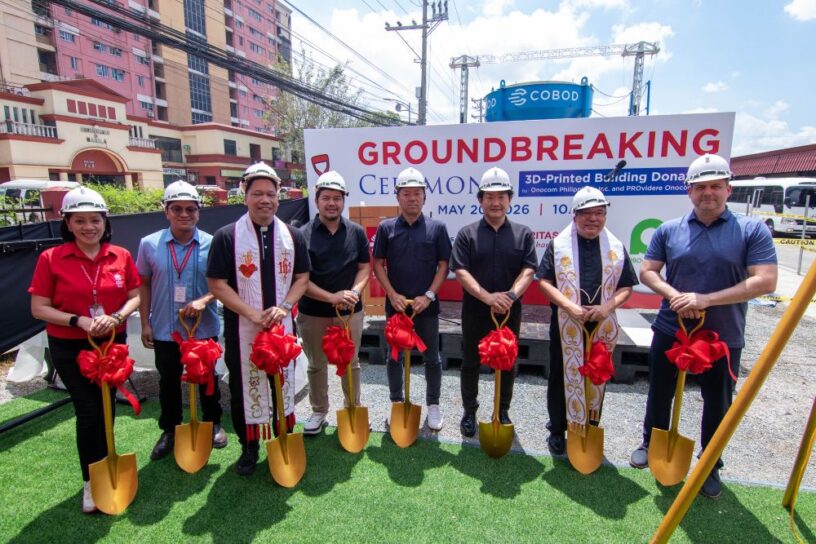



The landscape of Philippine construction just took a massive, automated leap into the future—and it’s all for a great cause. On May 20, 2026, the grounds of the Caritas Manila Headquarters in Paco, Manila, became the backdrop for a historic milestone. Caritas Manila, in a groundbreaking partnership with the Onocom Group, officially kicked off construction on the country’s very first 3D-printed building.
This isn’t just a win for the tech and architecture communities; it’s a powerful demonstration of how cutting-edge innovation can be geared toward humanitarian good and social development.
A Launch Rooted in Charity and Innovation
The groundbreaking event marked the introduction of large-scale 3D concrete printing (3DCP) technology to the local construction landscape. The multi-purpose facility is a generous donation borne from the collaborative efforts of Onocom Japan, Onocom Philippines, and Providere Onocom.
By integrating strict Japanese engineering standards—a hallmark of the Onocom Group since 1934—with modern construction practices, the project aims to build a sustainable, people-centered space.
Once completed, this pioneering structure will serve as a vibrant hub for Caritas Manila’s core initiatives, including:
- Skills training programs for local communities
- Social development initiatives and livelihood projects
- Disaster response operations and emergency relief coordination
- Religious activities and community gatherings
“We hope that this multipurpose center brings people together to appreciate both charity and innovation,” shared Rev. Fr. Anton C.T. Pascual, Executive Director of Caritas Manila.
From Small Plastic Toys to Concrete Real Estate: The 3D Printing Evolution
To appreciate the gravity of this project, it helps to look at how far 3D printing has come. The technology, scientifically known as additive manufacturing, actually dates back to the 1980s.
The Historical Timeline
- 1981: Dr. Hideo Kodama of the Nagoya Municipal Industrial Research Institute first invented the concept of fabricating three-dimensional plastic models layer by layer using photopolymers.
- 1984 & 1986: Charles “Chuck” Hull developed and patented Stereolithography (SLA), creating the first commercial 3D printer. For decades, the technology was strictly used for “rapid prototyping”—making small, plastic scale models, dental molds, and automotive parts.
- The 2000s–Present: As patents expired and material science evolved, innovators realized they could scale the machines up. Instead of extruding liquid plastic, industrial-grade 3D printers were engineered to extrude specialized concrete mixes, paving the way for 3D Concrete Printing (3DCP).
Why 3D Printing is a Game-Changer for Modern Construction
Traditional building construction is notoriously labor-intensive, time-consuming, and materially wasteful. Large-scale 3D concrete printing completely flips the script by deploying massive robotic gantry systems or mechanical arms that precisely extrude a specialized concrete mixture layer by layer based on a digital blueprint.
[Digital 3D CAD Model] ➔ [Robotic Printer Extrusions] ➔ [Layer-by-Layer Concrete Facility]
The Key Structural Advantages
- Unmatched Efficiency: Because the automated printing system runs continuously based on digital coordinates, structures that traditionally take months to frame can have their core walls erected in a matter of days or even hours.
- Zero Material Waste: Traditional construction requires building extensive wooden or metal formworks (molds) to pour concrete, much of which gets discarded. 3D printing places material only exactly where it is structurally required, radically minimizing construction waste.
- Enhanced Precision and Design Freedom: Automated systems eliminate human error in the structural framework. Furthermore, because computers drive the printer nozzle, architects can easily create curved, organic walls and complex geometric shapes that would be incredibly difficult or expensive to build using standard methods.
Engineering a Brighter, More Sustainable Tomorrow
Choosing Caritas Manila—the premier social service and development ministry of the Archdiocese of Manila—as the beneficiary ensures that this technological leap serves the people who need it most. For an organization deeply involved in rapid disaster response and poverty alleviation, pioneering a technology that offers fast, precise, and sustainable building solutions is a perfect fit.
As the printers spin up and the concrete layers begin to rise in Paco, this project serves as a brilliant proof of concept for the rest of the country. It proves that tomorrow’s tech doesn’t belong exclusively in corporate boardrooms or luxury developments—it can be used right now as a powerful tool to build hope, community, and social good.

- Santé International Inducted into DSAP, Reinforcing Commitment to Ethical Direct Selling - October 22, 2026
- Rethinking Nicotine: Inside the Push for Broader Tobacco Harm Reduction Across Asia - October 19, 2026
- Rediscover the Magic: I Heart PH Takes You on an Unforgettable Journey to Hong Kong in Season 11 - October 19, 2026
























Leave a Reply